


CTUIR's Pilot Project for Climate Adaptation in Action!
CTUIR's Food Waste Assessment is available below!
Executive Summary
The Confederated Tribes of the Umatilla Indian Reservation (CTUIR) is the federally-recognized Tribal government that represents the Cayuse, Umatilla, and Walla Walla Tribal peoples, and governs services and activities on the Umatilla Indian Reservation (UIR).
For CTUIR, First Foods are culturally significant plants and animals that are part of a seasonal round relationship. Annual Feast ceremonies welcoming back First Foods every year, and involve preparation and consumption of both First Foods as well as non-First Foods that have become a staple of the Longhouse meal table. Because of this strong food-dependent culture, our project focuses on this Longhouse community to promote and understand necessary behavior change starting at a community level. With this behavior change, this pilot project explores what resource recovery success and its benefits look like for this unique Tribal community. Food waste diversion initiative documented in this Food Waste Assessment is an attempt to address First Foods with respect at all steps.
Much of the population density on the UIR is clustered around the Mission area, known in the Umatilla Tribal language as Nixyáawii, which includes the Tribal Nixyáawii Governance center Center and Nixyáawii School, as well as a corner market, Elders and Youth services facilities, housing areas, an economic development corridor that attracts consumers from the nearby Federal Interstate I-84 which transects the Umatilla Indian Reservation, and the cultural and community gathering space at the Longhouse.
Our project service area was a roughly 1 mile radius around the Longhouse, which included a number of “host sites” that agreed to participate with the project. These host sites include the Nixyáawii Longhouse Feasts and select other events, the CTUIR DCFS Family Engagement Program’s Culture Nights hosted weekly at the Longhouse, the Nicht-Yow-Way Seniors Center operated by the Yellowhawk Tribal Health Center, the CTUIR Dept of Education’s Afterschool Program, and select residents of Mission. Our project aims to understand the weight, volume, and types of food waste created by our project host sites to plan strategically for the methods and scale of a large organics recovery facility to serve our larger Tribal community.
This project creates a baseline understanding of how frequently Tribal entities create food and other organic waste, what the general type and quality is, and what methods of food waste processing would be best to transition this food waste into a recovered resource material.
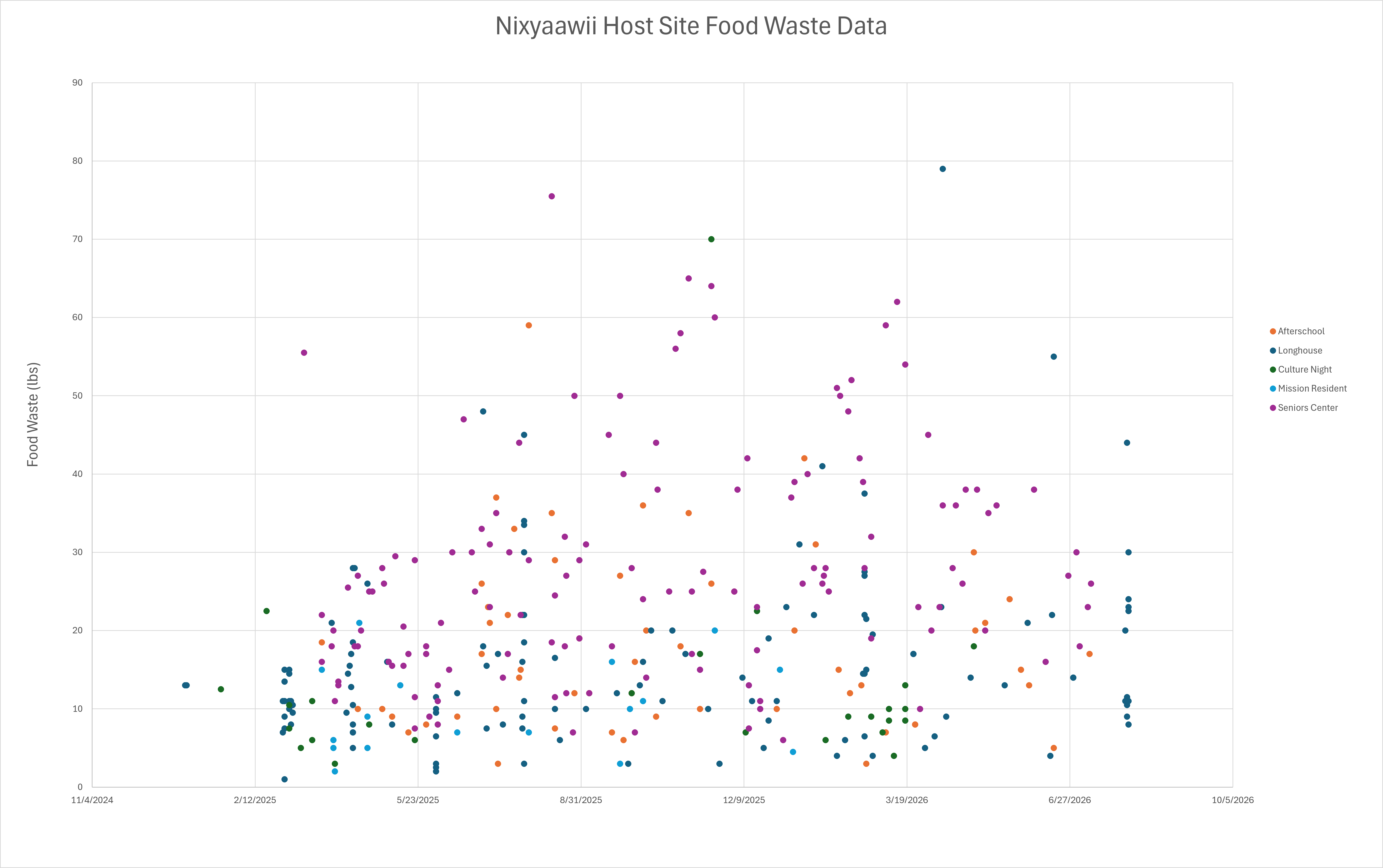
Nixyaawii, Don't Throw It Away! Project Host Site Food Waste Data for both project years October 2024 to September 2026
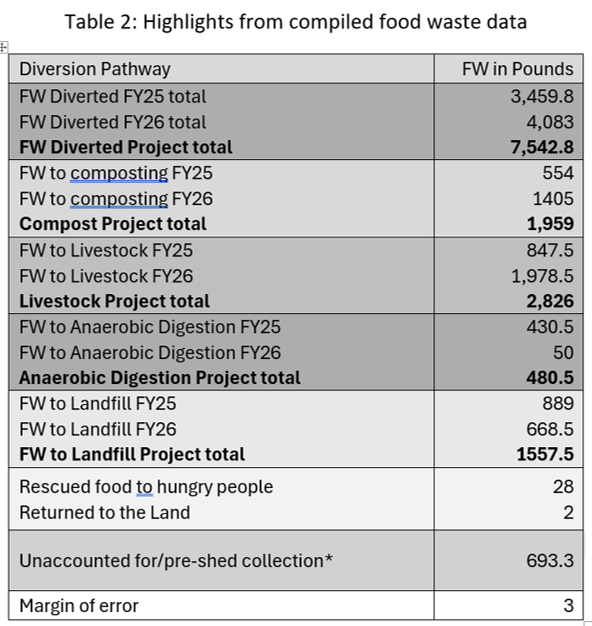
Nixyaawii, Don't Throw It Away! Project Host Site Food Waste Table 2 from the CTUIR Nixyaawii Food Waste Assessment (2026)
Food Waste Audit Data
Please find detailed information about food waste collection methodology and data in the full report and its appendices.
Community Perception and Survey Data was also collected as part of this assessment.
Highlighted community responses include:
- 94% of community felt reducing food waste at CTUIR events and food service programs was either Extremely Important or Very Important
- 54% of Tribal community diverts food waste at home All the Time or Often
- Leftovers make up 63% of food disposed at homes while First Foods make up less than 2%
- Food spoiling or becoming stale was the primary reason food is thrown away at 62% of FW
- Reducing waste in all aspects is a primary motivator for food waste prevention at 66%
- 60% said they would participate in a community-scale organics recovery operation
- Lack of knowledge in community was the biggest concern for a large operation at 45%
Food waste collected was processed into diverse locations including a trial anaerobic digester, to local livestock, to composting methods like Bokashi, Vermicomposting, and Aerobic composting. Bio-gas research was explored during this project, and unsuccessful trials illuminated requirements for a successful trial that include airtight design, temperature stability, fresh manure for maximum microorganisms, and insulated design with easy input and output access. Carbon emissions prevented from food waste recovery are measured in vehicle travel prevented. Our project estimates a prevention of 4,312,354 gCO2 emissions prevented over 2 years. This is a rough estimate; FWA data can be used to understand a community scale operation’s carbon reduction potential through the ODEQ Waste Impact Calculator.
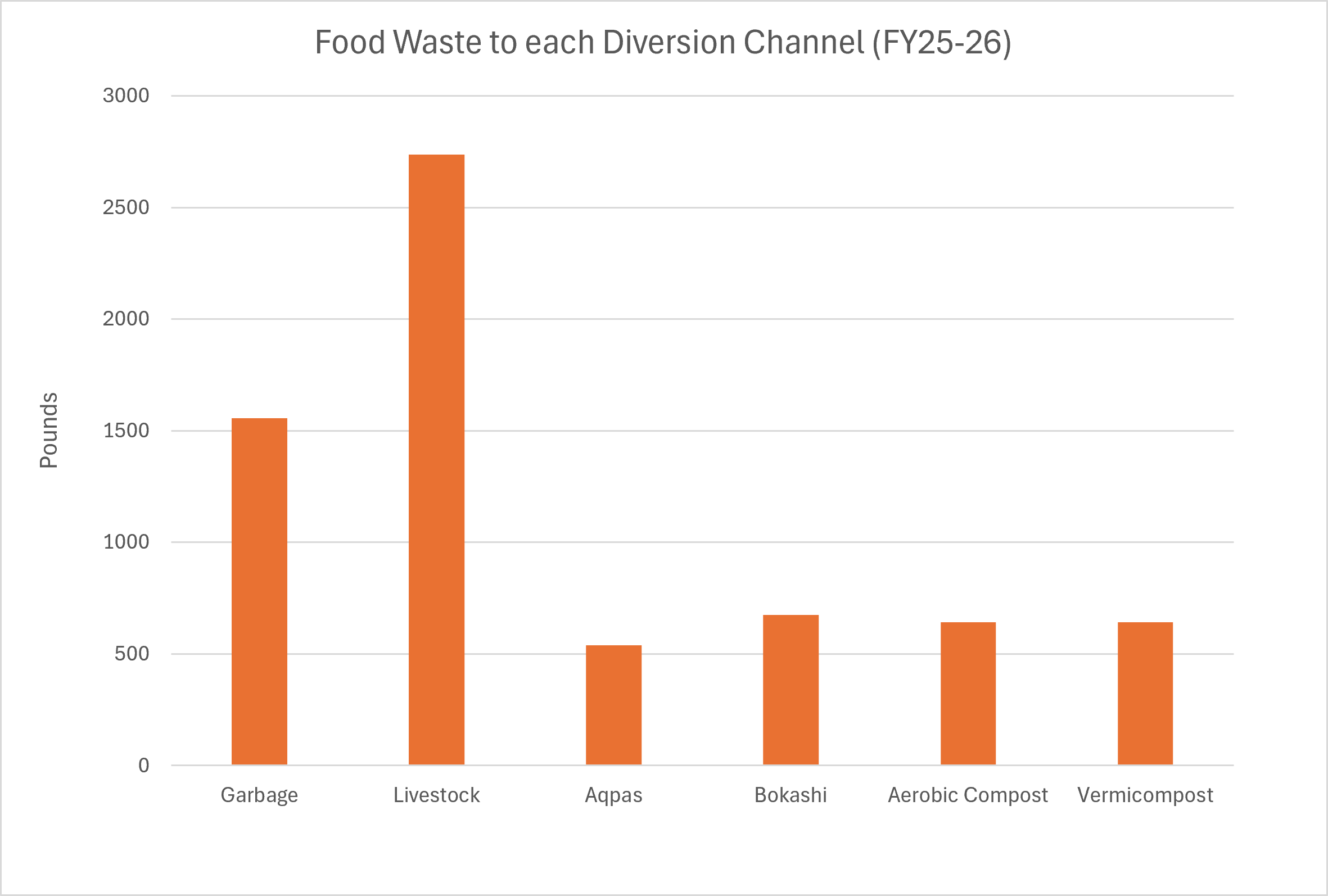
Nixyaawii, Don't Throw It Away! Project Host Site Food Waste Data diverted to various recovery pathways for both project years, Oct 2024 to Sept 2026.
Project Media Coverage
Media Coverage of the Nixyaawii, Don't Throw It Away! Project:
Umatilla tribes to launch food waste reduction project in northeast Oregon reservation - OPB
Nixyaawii, Don’t Throw It Away tackles food waste - Elkhorn Media Group
How are the Cayuse, Umatilla and Walla Walla tribes working to take care of their food waste?
Thank you to all who supported this project!
Funding Agency Disclaimers
This material is based upon work supported by the U.S. Department of Agriculture, under agreement number 2024-70510-41990.
Any opinions, findings, conclusions, or recommendations expressed in this publication are those of the author(s) and do not necessarily reflect the views of the U.S. Department of Agriculture. In addition, any reference to specific brands or types of products or services does not constitute or imply an endorsement by the U.S. Department of Agriculture for those products or services.
USDA is an equal opportunity provider, employer, and lender.
Webpage updated: Oct 15 2026